
Training
Your First Kettlebell: Five Moves To Start
November 3, 2026 · Theo, Lifting coach
A kettlebell is the most honest piece of gear in the room: one handle, one weight, nowhere to hide. This is how I start every new lifter on our garage floor — five moves, one bell, twenty minutes.
Pick The Right Weight
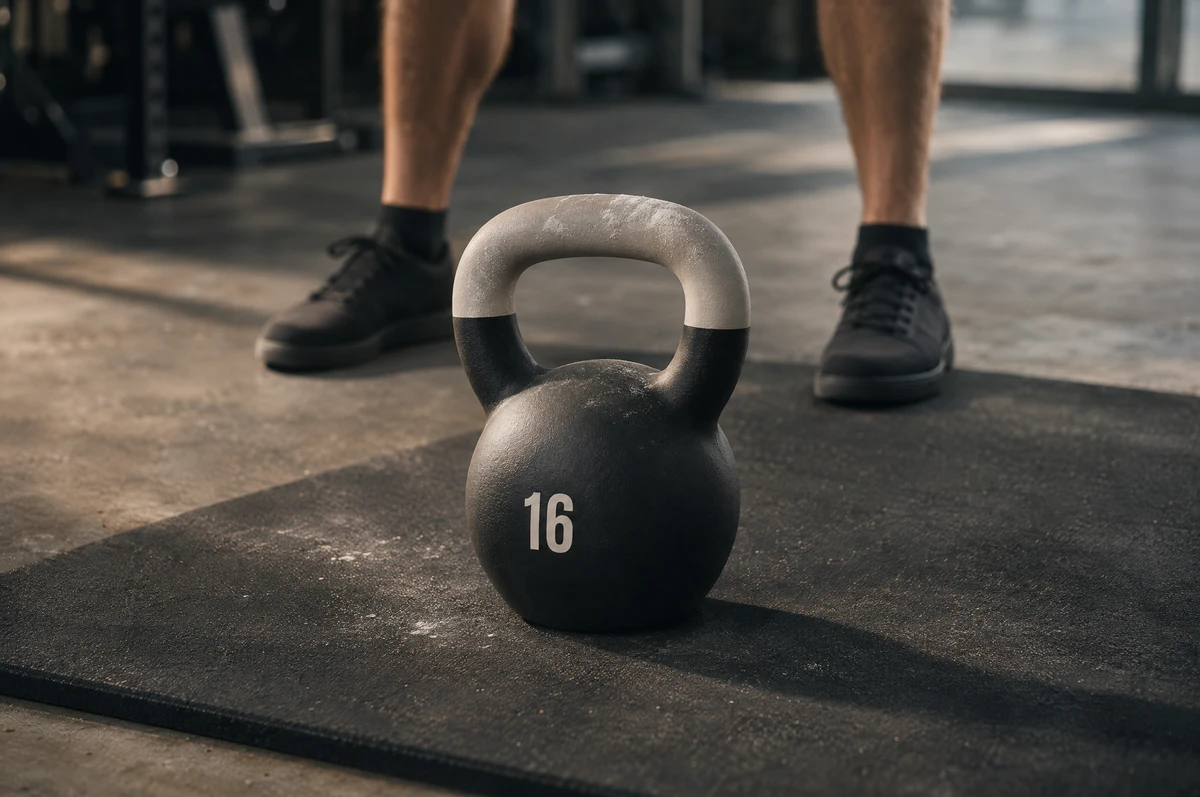
Most people buy a bell that is too light and get bored in a month, or one that is too heavy and get hurt in a week. Our bells start at 16 kg, and that is the weight I hand most first-timers for deadlifts and swings — your hips are stronger than you think. If 16 kg feels heavy in a goblet squat, hold it by the horns close to your chest and cut the reps. It gets lighter in three weeks; that is the point.
Give yourself a clear patch of floor about two metres across, flat shoes or bare feet, and nothing behind you that you would mind a bell landing on.
The Five Moves
Learn them in this order. Each one teaches you something the next one needs.
- Deadlift — the bell between your feet, push your hips back, flat back, stand up tall. This is the hinge, and everything else is built on it.
- Two-hand swing — the same hinge, fast. Hike the bell back between your thighs, snap your hips forward, let it float to chest height. Your arms are ropes, not levers.
- Goblet squat — the bell at your chest, elbows inside your knees, sit down between your heels and stand back up.
- Half-kneeling press — one knee down, squeeze the glute on that side, press the bell overhead with the opposite hand. Ribs down, no lean.
- Suitcase carry — the bell in one hand at your side, walk 20 metres without tipping towards it. Switch hands, walk back.
Put It Together
Do three rounds: 8 deadlifts, 10 swings, 8 goblet squats, 5 presses per arm and one carry each way. Rest a minute between rounds. Three sessions a week, on days that are not back to back. When three rounds feel easy, go to four. When four feel easy, go to five. Only then is it time for a heavier bell — not more reps.
Three Mistakes I See Every Week
Squatting the swing instead of hinging it. Lifting the bell with your arms instead of throwing it with your hips. And rushing the press — if your lower back arches, the bell is too heavy for that arm today. None of these is a reason to stop; each is a reason to slow down.
Learn the hinge before you chase the weight. The bell will wait for you.— Theo, lifting coach
We trained with the first Cast Kettlebell for three months before we sold a single one, and it is still the bell I reach for every morning. Start with the 16 kg, give it six weeks of three sessions, and you will know exactly which bell comes next.